
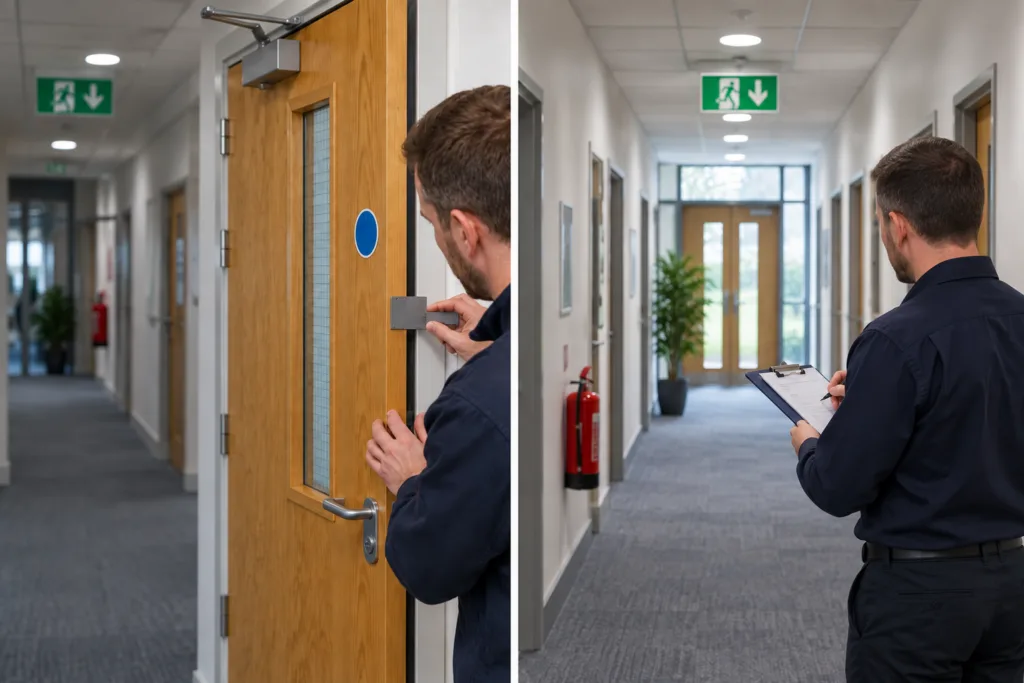
Updated September 2026. This cornerstone guide explains the main fire risk assessment duties affecting workplaces and relevant premises in England and Wales, with additional notes where England-specific residential fire-safety rules apply. Scotland and Northern Ireland have separate fire-safety regimes.
A fire risk assessment is the foundation of effective fire-safety management. It should identify fire hazards, the people who may be at risk, the precautions already in place and the further measures needed to reduce risk. It is not simply a certificate or a one-off inspection: it is a working assessment that should remain relevant as the building, occupancy and activities change.
SJ Fire Safety Consultants provides fire risk assessments with clear findings and practical action plans for businesses, landlords, managing agents, care providers and other Responsible Persons.
Request an assessment quote Call 0330 301 0255
Tell us the property postcode, use and approximate size so we can discuss the scope.
Contents
- What the law requires
- Who is responsible?
- The five-stage assessment process
- What a fire risk assessment should consider
- Recording findings and action plans
- How often the assessment should be reviewed
- Who can carry out a fire risk assessment?
- Blocks of flats, HMOs and landlords
- Care homes and vulnerable occupants
- Cost and quotation factors
- What happens after the assessment?
- Frequently asked questions
What does UK fire-safety law require?
For premises covered by the Regulatory Reform (Fire Safety) Order 2005, the Responsible Person must ensure that a suitable and sufficient fire risk assessment is carried out and kept under review. GOV.UK summarises the process as identifying hazards, identifying people at risk, evaluating and reducing risks, recording findings and planning, and reviewing the assessment regularly.
Official guidance: GOV.UK fire risk assessments and the Regulatory Reform (Fire Safety) Order 2005, Article 9.
The Fire Safety Order applies broadly to workplaces, commercial and public premises, and relevant common parts of multi-occupied residential buildings. Government guidance also explains that the Fire Safety Act 2021 clarified that the structure, external walls and flat entrance doors of relevant buildings can fall within the Fire Safety Order’s scope.
For a wider legal overview, see the Home Office collection on fire-safety legislation and guidance for those with legal duties.
Who is the Responsible Person?
The Responsible Person can vary depending on who controls the premises. GOV.UK identifies employers, owners, landlords, occupiers and other people with control—such as facilities managers, building managers or managing agents—as examples of people who may hold fire-safety responsibilities.
Where there is more than one Responsible Person, they need to cooperate and coordinate. This is common in shared commercial buildings and managed residential developments.
Read our detailed guide: Who Is Responsible for a Fire Risk Assessment?
Official guidance: GOV.UK: Who’s responsible for workplace fire safety?
The five-stage fire risk assessment process
1. Identify fire hazards
The assessment should consider possible sources of ignition, fuel and oxygen. Examples can include electrical equipment, cooking, heating appliances, hot works, smoking materials, charging equipment, combustible storage and flammable substances.
2. Identify people at risk
The assessment should identify who may be harmed if a fire occurs. This includes employees, visitors, contractors and members of the public, but particular attention should be given to people who may be especially at risk, including older people, young children and people whose mobility, sensory ability, cognition or health may affect evacuation.
3. Evaluate, remove or reduce the risks
Once hazards and people at risk are identified, the Responsible Person should evaluate the existing precautions and decide whether further controls are required. The aim is to reduce the likelihood of fire and make sure people can safely respond and escape if a fire occurs.
4. Record findings, plan and provide information/training
The Responsible Person should maintain a written record of the assessment, significant findings and the fire-safety arrangements in place. The emergency plan should reflect the building and the people who use it. Staff information and training should support those arrangements.
5. Review and update
The assessment should be kept under review. A document that no longer reflects the building, occupancy or fire precautions is not a reliable basis for fire-safety management.
What does a fire risk assessment look at?
The exact scope depends on the premises, but a professional assessment may consider:
- means of escape, final exits and protected routes;
- fire detection and warning systems;
- emergency lighting;
- fire doors and compartmentation;
- firefighting equipment;
- signage and notices;
- electrical, heating, cooking and other ignition risks;
- combustible and hazardous materials;
- housekeeping and storage;
- arrangements for vulnerable people or those needing assistance;
- fire-safety management, staff responsibilities and emergency plans;
- testing, maintenance and inspection records;
- staff information, instruction, training and fire drills;
- contractor control and building works that may affect fire precautions.
A fire risk assessment is different from a detailed specialist survey. For example, the assessment may identify concerns about fire doors that justify a separate fire door inspection with door-by-door findings and photographs.
What should be recorded?
A useful report should do more than state that something “passes” or “fails”. It should give the Responsible Person a clear record of the premises, the significant findings and the actions required.
Typical reporting may include:
- premises details and assessment scope;
- the people and groups considered to be at risk;
- the fire hazards and existing preventive measures;
- escape, detection, lighting, door and management observations;
- significant deficiencies or areas requiring improvement;
- a prioritised action plan;
- supporting photographic evidence where useful; and
- the basis for future review.
See what you receive from SJ Fire Safety Consultants and our illustrative sample report structure.
How often should a fire risk assessment be reviewed?
There is no single fixed statutory review interval that applies to every building. The Fire Safety Order requires the assessment to be reviewed regularly, and it should be reviewed when there is reason to believe it is no longer valid or when there has been a significant change.
Examples that can trigger review include:
- changes to the building layout or use;
- significant changes in occupancy;
- new equipment, processes or hazardous materials;
- alterations to escape routes or fire precautions;
- building work that affects compartmentation;
- a fire or significant incident;
- deterioration or repeated defects in fire doors or other precautions; and
- changes in the needs of vulnerable occupants.
For more detail, see How Often Should a Fire Risk Assessment Be Reviewed?
Who can carry out a fire risk assessment?
The legal duty remains with the Responsible Person, even when someone else is appointed to assist. For simple premises, a person with sufficient knowledge and understanding may be able to carry out the assessment. More complex, unusual or higher-risk premises may justify professional assistance.
The key question is whether the person carrying out the work has enough knowledge, training and experience for the complexity of the premises and the risks involved.
Government guidance for people with fire-safety duties is available in the Home Office guide for persons with duties under fire-safety legislation.
Fire risk assessments for blocks of flats, HMOs and landlords
Residential fire safety can involve overlapping legislation and responsibilities. The Fire Safety Order applies to relevant common parts and building elements, while housing, licensing and building-regulation duties may also apply separately.
HMOs
HMOs can combine sleeping risk, several households and shared escape routes. The assessment may need to consider protected routes, fire doors, detection, emergency lighting, management arrangements and the behaviour or needs of occupants.
Read: Fire Risk Assessment Requirements for HMOs and Landlords.
Blocks of flats
In England, flat entrance doors, the structure and external walls can be relevant to the Fire Safety Order. The Fire Safety (England) Regulations 2022 also introduce additional duties for certain multi-occupied residential buildings.
Read: Fire Safety Compliance for Blocks of Flats: A Managing Agent Guide.
Managing agents
Property managers often coordinate inspections, records, residents and remedial work across multiple buildings. The legal responsibilities still depend on who controls the premises and relevant fire-safety matters.
Read: Fire Risk Assessments for Landlords and Managing Agents and our dedicated fire safety support for property managers.
Fire risk assessments for care homes and vulnerable occupants
Care environments often require deeper consideration because evacuation can take longer and some residents may need assistance. The assessment should reflect resident needs, staff availability, evacuation arrangements, detection, compartmentation, fire doors and management procedures.
Read: Fire Risk Assessments for Care Homes: What to Expect and our care-home fire-safety service page.
Official guidance: GOV.UK fire-safety risk assessment guidance for residential care premises.
How much does a fire risk assessment cost?
Cost depends on the time and complexity required to inspect the premises and prepare a suitable report. Factors can include building size, number of floors, occupancy, sleeping risk, complexity of escape arrangements, available documentation, number of buildings and the level of reporting required.
Read: How Much Does a Fire Risk Assessment Cost?
Local fire risk assessment guides
SJ Fire Safety Consultants has also published location-specific guidance that combines national duties with relevant local-authority HMO information:
- Fire Risk Assessments in Northampton
- Fire Risk Assessments in Milton Keynes
- Fire Risk Assessments in Bedford
- Fire Risk Assessments in Luton
Further local guides: fire risk assessments in Leicester and fire risk assessments in Coventry.
What happens after the assessment?
The report should lead to action. The Responsible Person should review the findings, assign responsibility for actions, prioritise higher-risk issues, obtain appropriate specialist advice or repairs, retain evidence of completed work and update the assessment where necessary.
Where the report identifies fire-door concerns, a detailed fire door inspection may help define the exact defects and remedial work required. Where staff arrangements need improvement, fire safety training can support the emergency plan and the findings of the assessment.
Fire risk assessment FAQs
Is a fire risk assessment a legal requirement?
For premises within the scope of the Fire Safety Order, the Responsible Person must ensure a suitable and sufficient assessment is carried out and kept under review.
Does every building need a new assessment every year?
No single annual replacement rule applies to every building. The assessment must be reviewed regularly and when it may no longer be valid or significant changes have occurred.
Can a landlord be the Responsible Person?
Yes. Depending on control of the premises, a landlord, owner, managing agent, employer or occupier may be a Responsible Person or share duties with others.
Does a fire risk assessment include fire doors?
It should consider whether fire doors and passive fire precautions are appropriate to the risks. A separate detailed fire-door inspection may be recommended where door-by-door assessment is needed.
Does the assessor fix the problems?
The assessment identifies and prioritises issues. Remedial work should be carried out by people competent for the work required. Keeping assessment and remedial procurement appropriately separate can also help preserve the independence of the assessment.
What should I provide before an assessment?
Useful information can include previous assessments, fire strategy documents, plans, alarm and emergency-lighting records, door inspection records, training/drill records and details of significant changes to the premises.
Arrange a Fire Risk Assessment
SJ Fire Safety Consultants provides independent fire risk assessments with clear reporting and practical recommendations. We support individual premises and multi-site portfolios across the UK.
View our Fire Risk Assessment service or contact us to request a quotation.